Bulk buyers choosing a China-based supplier of Golden Breadcrumbs need more than a competitive price. Particle size, color, moisture, and coating performance can affect how crumbs look and behave in production. A sample tells part of the story. Repeat orders reveal more.
For this guide, illustrative sourcing expert Alex Chen offers a practical rule: “A reliable crumb should perform consistently in the buyer’s process, not just look right in a sample.” Treat that as a buying principle, not a verified quotation from a real-world expert. Ask suppliers for product specifications, ingredient details, allergen information, packaging options, and batch records. Then compare samples under the conditions your product actually faces: a hot oven, a fryer, or a short trip from kitchen to serving tray. Small differences show up fast.
A useful supplier discussion also covers production capacity, lead times, minimum order quantities, and how changes are communicated. Request clear answers in writing. Check whether the supplier can explain its quality checks and provide documents relevant to your shipment. Details matter. Yet a polished brochure cannot prove consistent production. I would not treat one successful sample as a guarantee; that assumption deserves a second look. For bulk buyers, a careful comparison of specifications, samples, and service offers a steadier basis for choosing a Golden Breadcrumbs supplier.
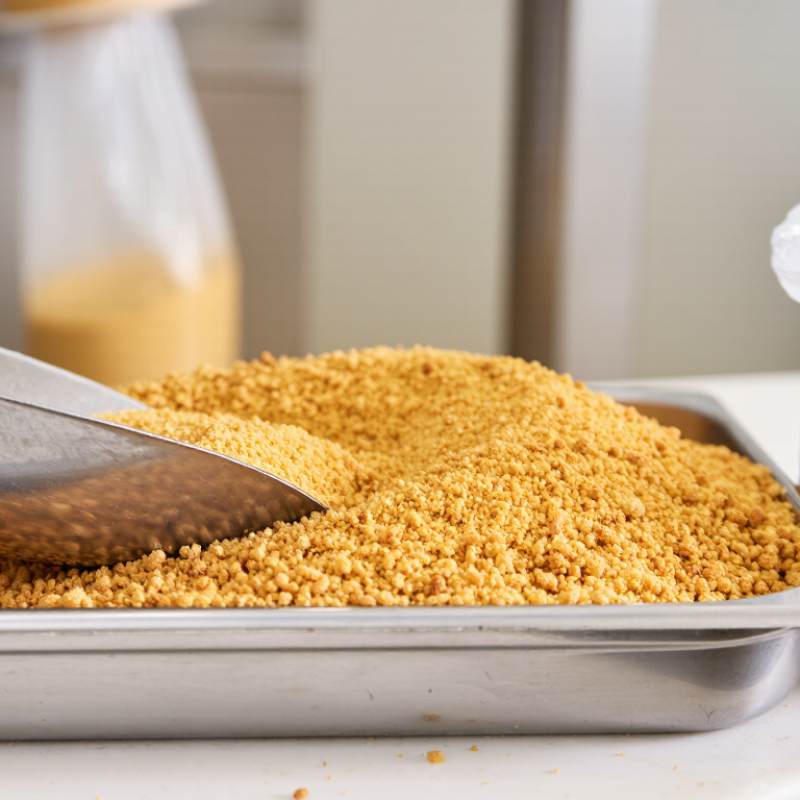
Golden breadcrumbs are dried, finely broken pieces of bread with a warm yellow-gold color. They add a crisp coating to foods such as baked vegetables, fish, or cutlets. Their texture can range from fine and sandy to coarse and flaky. Small differences matter.
Most are made by mixing flour, water, yeast, and other recipe ingredients into dough, then baking it into bread. The bread is cooled and dried to reduce moisture before milling. Controlled toasting may deepen its golden color and roasted aroma. The crumbs are then screened into selected sizes, while oversized pieces may be milled again. Recipes differ, so color and flavor are not identical across suppliers.
For bulk buyers, useful checks include particle size, moisture level, color consistency, and ingredient details. These affect coating coverage, storage stability, and performance during cooking. A fine crumb clings closely; a coarser one gives a more visible crunch. Color alone can mislead. Lighting and natural variation may make two samples look different, even when their cooking results are similar. Testing a sample in the intended recipe is a practical way to assess fit.

For bulk buyers, golden breadcrumbs should be assessed by more than their bright appearance. Check particle size, moisture level, color consistency, and ingredient details against a written specification. Fine crumbs coat evenly, while coarse crumbs create a stronger, crunchier surface. Neither is automatically better; the right grade depends on the food and cooking method. Color should look consistent across samples. A few darker flakes may be harmless, but frequent variation can signal uneven processing.
Ask suppliers for current product specifications and a representative sample before confirming a large order. During testing, record coating coverage, adhesion, and crispness after frying or baking. Check moisture and packaging condition on arrival, too. Damp crumbs can clump and coat poorly. Review applicable microbiological and allergen information for your own production requirements. Results can vary between batches, so retain a sample when practical. One test is not always enough.
Tips: Compare samples using the same food, coating method, and cooking time. Keep notes on crumb size and color. Small differences matter. If a specification seems unclear, ask for measurable limits rather than relying on terms like “uniform” or “golden.”
Indicative procurement specifications for bulk golden breadcrumbs. Actual limits should be agreed with the supplier and checked against the applicable food regulations and product use.
| Quality parameter | Indicative bulk specification | Suggested verification |
|---|---|---|
| Appearance and color | Uniform golden to light golden-brown; free from visible foreign matter, scorching, and excessive dark particles. | Visual inspection against an agreed reference sample. |
| Aroma and flavor | Clean toasted-bread aroma and flavor; no rancid, musty, burnt, or other off-notes. | Sensory assessment of a representative sample. |
| Moisture | Target: ≤10% by weight. | Moisture analyzer or validated oven-drying method. |
| Particle size | Specify to the intended use; for example, a medium crumb with most particles passing a 2.0 mm sieve and retained on a 0.5 mm sieve. | Sieve analysis; agree sieve range and allowable fines with the buyer. |
| Bulk density | Record the agreed product-specific target in g/L; results vary with crumb size and packing method. | Measure using a defined container, filling method, and no-tapping or tapping procedure. |
| Ingredients and allergens | Declare all ingredients and processing aids. Wheat breadcrumbs contain gluten; identify other regulated allergens where applicable. | Review ingredient statement, allergen declaration, and cross-contact controls. |
| Microbiological criteria | Set limits with the supplier and destination-market requirements. A buyer may specify Salmonella absent in 25 g as a purchase criterion. | Use a qualified laboratory and agreed sampling plan; applicable legal limits take precedence. |
| Foreign matter and infestation | Free from insects, webbing, stones, metal, and other extraneous materials. | Visual inspection and review of the supplier’s foreign-material control program. |
| Packaging | Food-grade, sealed moisture-barrier bags; bulk pack size and outer packaging to be agreed for shipment and handling. | Check seal integrity, pack weight, lot code, and packaging suitability for food contact. |
| Shelf life and storage | Use the validated shelf life stated on the product label. Store sealed in a cool, dry place, away from moisture and strong odors. | Review shelf-life support, production date, best-before date, and storage instructions. |
| Batch documentation | Provide lot identification and a certificate of analysis or equivalent batch quality record where agreed. | Match documents and lot codes to the delivered goods. |
China Best Golden Breadcrumbs Supplier for Bulk Buyers
How to Assess Golden Breadcrumbs Suppliers in China
Assess suppliers by product consistency, not price alone. Request samples from several production lots and compare color, particle size, moisture, and coating performance. For example, fry the same chicken portion using each sample; uneven browning or excess crumbs in the fryer can reveal real differences. Ask for product specifications, batch-level certificates of analysis, ingredient lists, and traceability records. A certificate is useful, but it does not replace testing.
Raw-material scale is only background evidence. USDA’s 2024 China Grain and Feed Annual estimated China’s 2024/25 wheat production at about 140 million metric tons. That figure signals a large wheat supply, not a guarantee of breadcrumb quality or factory capacity. Verify the supplier’s actual production line, allergen controls, foreign-material checks, and moisture-testing method. Request recent third-party audit documents and confirm their scope and validity. I would also check how the supplier handles a failed lot; this detail is easy to overlook.
Tips: Specify crumb size, color range, packaging, and acceptable moisture before ordering. Keep a sealed reference sample from the approved batch. Then compare incoming lots against it. Good paperwork helps, but the fryer tells part of the story.
Suggested assessment weighting for bulk buyers (%)
Use these suggested weights to compare suppliers against your own requirements. They are a buyer-oriented assessment framework, not market survey results or ratings of specific companies.
Bulk buyers should confirm crumb size, color, moisture level, and intended use before placing a large order. A sample can show whether the coating stays crisp after frying or turns heavy in the fryer. Small differences matter. Ask for the product specification and check that the bulk batch matches the approved sample. It is easy to overlook this step when the order deadline is tight.
Packaging affects product quality during storage and transit. Food-grade inner liners help limit moisture exposure, while sturdy outer cartons reduce crushing during handling. For longer shipments, request details about pallet configuration, carton weight, and protective wrapping. These details help warehouse teams plan unloading and storage. Still, packaging alone cannot correct poor storage conditions at the destination.
Shipping plans should account for production time, transit estimates, and the receiving facility’s schedule. Confirm the quantity per carton and total pallet dimensions before booking freight; a mismatch can delay unloading or add handling costs. For a first order, a smaller trial shipment may reveal practical issues before regular deliveries begin. This can feel slower, but it offers useful evidence. Even careful planning has gaps, so leave room for inspection when the goods arrive.
Bulk buyers should treat golden breadcrumbs as a food ingredient that needs routine checks, not just a price line. At receiving, inspect the outer bags for tears, damp patches, broken seals, or unusual odors. Compare lot numbers with shipping documents, then check the product’s color and texture against an approved sample. A quick sieve check can help flag unexpected clumps or foreign material. Review supplier specifications for ingredients, allergen details, and moisture limits. Paperwork matters. But a certificate alone cannot show how a particular shipment was handled.
Tips: Keep a retained sample from each lot in a clean, labeled container. Record the delivery date, lot code, inspection results, and any follow-up. Small gaps matter.
Supplier management should continue between orders. Ask for notice of changes to ingredients, processing, packaging, or production sites. Review complaints and test results together, looking for repeated issues such as pale color, excess fines, or inconsistent coating performance. When a problem appears, agree on a corrective action and a date to check whether it worked. Keep communication specific and documented. We have learned that a tidy file can still hide a weak handoff, so confirm that updates reach the people receiving and using the breadcrumbs.
A&B has become the leader in fresh packing and cleaning equipment for fruits and vegetables worldwide. We have achieved this by relentlessly working to produce new and innovative ideas, along with the best customer service on Earth combined with hard working, dedicated, loyal employees and the latest industrial manufacturing techniques. We are now proud to say that we manufacture The Fulcrum Fresh Harvester, this is a one of a kind Berry Harvester that was specifically designed to handle fresh pick blueberries.
732 W. Saint Joseph Street
Lawrence, MI 49064
Phone: 269-539-4700 Fax: 269-539-4705
sale@industrialpackagingmachines.com