How to Choose the Right High Mast Lighting System
Choosing the right high mast lighting system begins with understanding the site, not browsing a product catalogue. A logistics yard, sports ground, airport approach, and highway interchange each require different lighting performance. Measure the illuminated area, mounting height, pole spacing, ground reflectance, and local weather exposure. Wind loads matter. So does corrosion.
A practical design should provide consistent illumination without creating harsh glare or dangerous dark zones. Review photometric data, beam angles, lumen output, color temperature, and lighting uniformity. LED fixtures can reduce energy use and maintenance visits, but efficiency figures alone do not guarantee a suitable system. Ask for verified test reports, warranty terms, ingress protection ratings, and documented performance from established manufacturers. Independent lighting engineers can also check calculations against applicable safety and electrical standards.
Maintenance deserves serious attention. Imagine a fixture failure above a busy yard during rain. Can technicians reach it safely? Does the pole support lowering equipment, or will specialized lifting machinery be required? These details affect long-term operating costs. Smart controls, photocells, and dimming schedules may improve efficiency, though poorly configured controls can reduce visibility.
Experience reveals uncomfortable truths. The cheapest quotation is rarely the cheapest solution. Even a well-designed system may need adjustment after installation because real surfaces, vehicles, and weather behave differently than software models. Review nighttime performance, record complaints, and refine settings when necessary. No selection is perfect. A reliable high mast system balances safety, coverage, durability, energy use, and realistic maintenance planning.
Define the Lighting Requirements and Site Conditions
How to Choose the Right High Mast Lighting System
Define the Lighting Requirements and Site Conditions
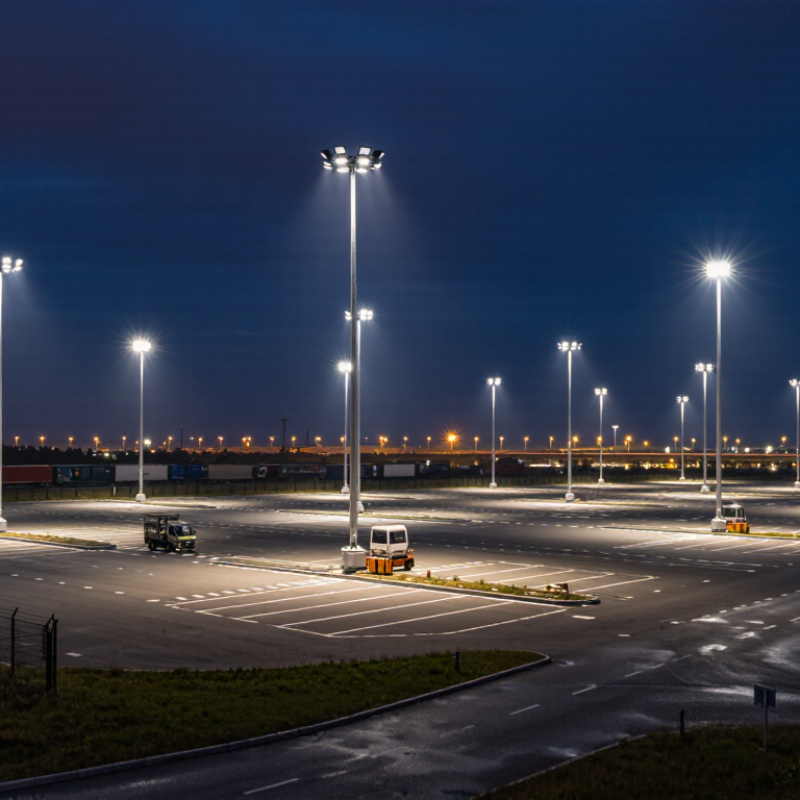
A high mast lighting project should begin with the activity below, not the pole above. Define the required illuminance, uniformity, glare limits, and operating hours for each area. A freight yard needs clear visibility around trailers, while a sports field requires balanced light across playing surfaces. Road junctions may require stronger attention to vehicle movement and pedestrian conflict points.
Walk the site during both daylight and darkness. Record pole locations, existing shadows, nearby homes, drainage paths, and access routes for maintenance vehicles. Measure the mounting area carefully. Soil strength, wind exposure, salt air, and seasonal weather can affect foundation design and equipment life. I once saw a layout fail because a storage building blocked light after construction. The drawing was accurate, but the site changed.
Use photometric calculations to test pole height, spacing, beam distribution, and energy demand. Check light trespass near windows and avoid placing intense beams toward drivers. Confirm the available electrical supply, control method, emergency needs, and cleaning access. Small details matter.
A practical review should include site photographs, measured dimensions, and a night-time inspection. Ask whether the proposed system remains serviceable when a lamp, driver, or control component fails. That question is often overlooked. Some early assumptions may be wrong, so revise the design after field verification and consultation with qualified lighting and structural professionals.
Compare High Mast Pole Designs and Mounting Configurations
Choosing a high mast lighting system starts with mounting configuration, not pole height. The Federal Highway Administration’s Roadway Lighting Handbook describes high mast applications commonly using 80- to 150-foot poles. At these heights, one pole can cover a large interchange, yard, or transport terminal. Yet coverage alone is not enough. IES RP-8-18 emphasizes maintained illuminance, uniformity, glare control, and visual comfort.
A fixed crown with multiple luminaires offers strong structural simplicity and fewer moving parts. It suits open sites where maintenance equipment can reach the pole safely. A lowering ring costs more initially, but technicians can service luminaires at ground level. That can reduce lane closures and simplify nighttime repairs. Maintenance access matters. In coastal or dusty environments, the ring mechanism also needs careful corrosion protection and inspection.
Mounting direction changes the result. Radial floodlights provide broad coverage, while adjustable tenon-mounted luminaires allow more precise aiming. Poor aiming can create bright pavement patches and dark gaps between poles. The U.S. Department of Energy’s 2023 Solid-State Lighting R&D Plan identifies 150 lumens per watt as a practical commercial benchmark for many LED products, but complete systems perform lower after optics, drivers, and thermal losses. Wind changes everything. Pole and ring designs should follow the project’s governing structural standard, such as ASCE 7, with local wind and fatigue conditions verified. In practice, specifications sometimes overvalue maximum output and undervalue access. That is a mistake worth revisiting.
Assess Energy Efficiency, Controls, Maintenance, and Durability
How to Choose the Right High Mast Lighting System
Choosing a high mast lighting system requires more than comparing lumen figures. Energy efficiency should be measured at ground level, not only at the fixture. LED optics can reduce wasted light across yards, ports, and large roadways. Ask for photometric files and a maintained-lighting calculation. This reveals weak assumptions. A lower-wattage fixture may still underperform if spacing is excessive. In my field evaluations, uniformity often matters more than peak brightness.
Controls can reduce energy use during quiet hours. Use scheduling, dimming, photocells, and motion sensing where traffic patterns support them. However, automated settings need proper commissioning. Poor calibration can leave dark zones or trigger unnecessary full-power operation. Request manual override and fault alerts. Networked controls provide useful data, but they add configuration and training requirements. Do not assume a dashboard guarantees savings. Review monthly energy records against operating hours. That comparison is practical.
Maintenance plans should specify access methods, inspection intervals, surge protection, and spare parts. A sealed housing, corrosion-resistant finish, and strong thermal design support longer service life. Check wind loading, vibration resistance, and temperature ratings for the site. Ask how technicians can replace drivers or lenses safely. Fast repairs matter. Yet published life ratings are not promises. Dust, heat, salt, and frequent cycling can shorten performance. I would trial one pole section before approving a full installation. That step may feel slower. It can expose glare, control delays, or difficult access before costs multiply.
Verify Safety Standards, Installation Needs, and Total Cost
Choosing a high mast lighting system starts with safety, not brightness. Verify compliance with IEC 60598-2-3, relevant national electrical codes, and photobiological safety requirements under IEC 62471. The U.S. Department of Energy’s 2023 Solid-State Lighting R&D Opportunities report records laboratory LED efficacy above 200 lumens per watt. However, field performance depends on optics, temperature, dirt, and maintenance. A powerful fixture can still create glare or uneven illumination.
Installation conditions deserve equal attention. Confirm wind-load calculations, pole height, foundation strength, cable routes, surge protection, and access for lowering the lighting ring. A coastal site may need stronger corrosion protection than an inland warehouse. Check the lifting mechanism before approval. It is often overlooked. Photometric software should test lux levels, uniformity, spill light, and mounting geometry using real site measurements. Guesswork becomes expensive after concrete is poured.
Evaluate total cost over the system’s service life, not only the purchase price. The International Energy Agency has reported that lighting represents about 15% of global electricity use, showing why efficiency affects operating budgets. Compare wattage, expected hours, replacement parts, labor, cleaning, controls, and energy tariffs. The U.S. DOE also reports that LED lighting can use at least 75% less energy than incandescent technology, though high-mast savings vary by application. The lowest quotation may hide frequent access costs. I would still challenge every projected payback period, especially when maintenance assumptions seem too optimistic.
How to Choose the Right High Mast Lighting System
Compare the estimated 10-year cost of three high-mast configurations while checking structural safety, installation requirements, and long-term operating expenses.
Planning assumptions: 4,000 operating hours per year, electricity at $0.15/kWh, LED system efficiency of approximately 130 lm/W, and routine maintenance included in the maintenance allowance. Actual costs depend on wind exposure, foundation conditions, lifting access, local labor rates, and required illumination levels.
Selection guidance: Verify that the pole and foundation are designed for the applicable local wind and structural requirements, confirm luminaire compliance with relevant lighting-safety standards such as IEC 60598-2-3 where applicable, and allow sufficient access for lifting equipment, electrical testing, and future maintenance.