Granular Seaweed Fertiliser is a plant-support product made from processed marine algae. It usually appears as small, dry pellets or granules. These particles are easier to store, measure, and spread than liquid seaweed extracts.
The material may contain organic matter, trace minerals, alginate, amino acids, and natural plant compounds. Its exact composition depends on the seaweed species and manufacturing process. Quality can vary between batches. That detail matters more than many product labels suggest.
After application, moisture softens the granules and releases soluble compounds around the root zone. Some ingredients may support microbial activity and improve soil structure. Others can help plants manage drought, transplanting, salinity, or temperature stress. The response is usually gradual, not dramatic.
Professor Patrick J. Stirk, a recognised seaweed-biostimulant researcher, has stated, “Seaweed extracts are not fertilizers, but biostimulants.” This distinction explains how Granular Seaweed Fertiliser works. It may support nutrient-use efficiency and root development, but it cannot replace every essential nutrient. Plants still need a balanced supply of nitrogen, phosphorus, potassium, and other elements.
The practical results depend on soil condition, crop type, weather, application rate, and product quality. A useful trial might compare treated and untreated plants in the same field. Measure root growth, leaf colour, yield, and soil moisture. Do not rely only on appearance.
The science is promising, but not perfect. Granular Seaweed Fertiliser is a support tool, not a miracle solution. Understanding its ingredients makes safer and more realistic decisions possible.
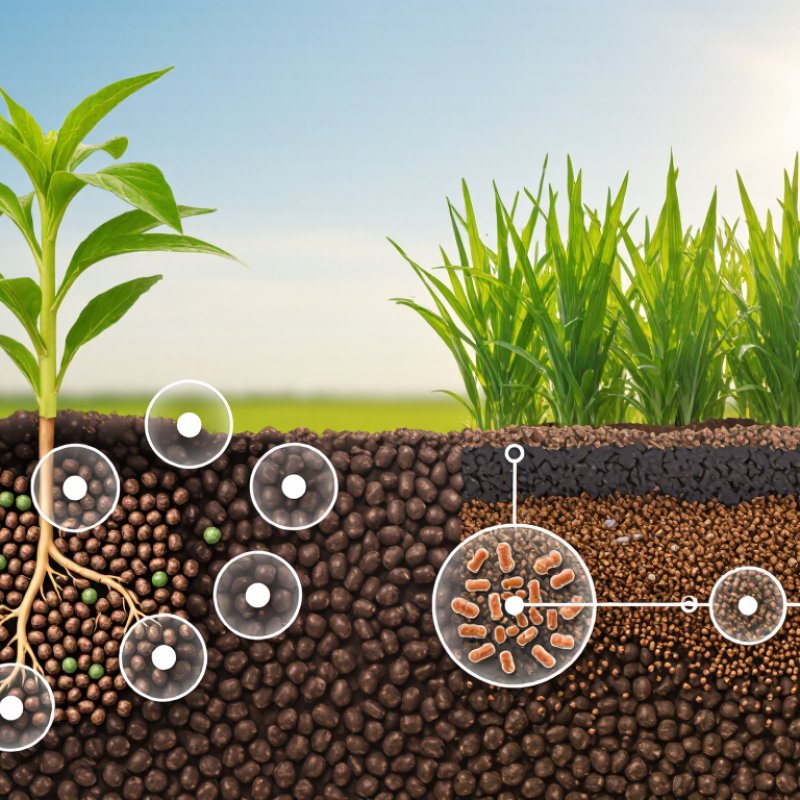
Granular seaweed fertiliser is a dry soil amendment made from processed marine algae. The seaweed is cleaned, dried, and crushed into small, easy-to-spread granules. Its nutrients vary by species and processing method. Most products contain modest amounts of nitrogen, potassium, minerals, and natural compounds such as alginates.
It works gradually, rather than acting like a quick green-up feed. After watering, the granules soften and release organic matter around plant roots. Alginates may improve moisture retention and support soil structure. Seaweed extracts can also encourage useful microbial activity, although results depend on soil quality, temperature, and moisture. It is not a complete fertiliser. A soil test remains more reliable than guessing. Plants may look unchanged for several weeks.
Tips: Sprinkle granules evenly over moist soil, then water them in thoroughly. Follow the packet rate, because more fertiliser can harm roots. Keep granules away from direct contact with seedlings and tender stems. For containers, use a smaller dose because nutrients accumulate faster. I prefer checking leaf colour and new growth before repeating an application. Some plants respond clearly; others show little visible change. That uncertainty is worth accepting.

What Is Granular Seaweed Fertiliser and How Does It Work?
Seaweed is harvested, rinsed, and inspected before processing. Workers remove sand, shells, and excess salt from the wet material. The cleaned seaweed is then dried carefully, often at a controlled temperature. Excessive heat can damage some naturally occurring compounds. This stage needs patience.
Once dry, the seaweed becomes brittle and easier to mill. It is ground into a coarse powder, then blended with moisture or a plant-based binding material. The mixture passes through a granulator, where pressure forms small, consistent particles. Some manufacturers use gentle drying afterward to stabilise the granules. Particle size matters because it affects handling and release in soil.
Good granules should flow easily from a spreader without producing excessive dust. When they contact moisture, they gradually soften and release soluble minerals and organic compounds. These materials can support soil microbial activity and improve nutrient availability, although results vary with soil type, crop, and application rate. In practical use, I would test a small area first. Granules may appear uniform, but their performance is not always uniform. Poor storage can also cause clumping. A cool, dry place usually protects their texture better. Testing the product label and observing plant response remains more reliable than expecting instant growth.
| Processing Stage | What Happens | Main Purpose | Typical Material Condition | Effect on the Final Granule |
|---|---|---|---|---|
| 1. Seaweed Collection | Seaweed is collected from marine environments and selected for processing. The raw material may include kelp, rockweed, or other brown seaweeds. | To provide organic matter, minerals, and naturally occurring seaweed compounds. | Fresh seaweed contains a high proportion of water and may contain sand, shells, salts, and other marine debris. | Raw-material quality influences nutrient content, cleanliness, colour, and final fertiliser consistency. |
| 2. Washing and Cleaning | The seaweed is rinsed or mechanically cleaned to remove sand, stones, excess surface salts, and other contaminants. | To improve material purity and protect drying and milling equipment. | Moist, cleaned biomass with reduced surface contamination. | Produces a cleaner granule and helps reduce unwanted physical impurities. |
| 3. Drying | Cleaned seaweed is dried using controlled air or thermal drying systems until it becomes suitable for milling. | To reduce moisture, limit microbial deterioration, and improve storage stability. | Commercially dried seaweed commonly has substantially less moisture than fresh seaweed; the exact target depends on the process and product specification. | Correct moisture is essential for efficient grinding and reliable granule formation. |
| 4. Milling and Size Reduction | The dried seaweed is crushed or milled into a relatively uniform powder or meal. | To increase surface area and create particles that can be blended and compacted. | Dry, free-flowing seaweed meal with a controlled particle-size distribution. | Finer, more uniform particles generally improve mixing, binding, and granule strength. |
| 5. Formulation and Conditioning | The seaweed meal may be blended with permitted fertiliser ingredients, binders, or moisture, depending on the intended nutrient analysis and granulation method. | To adjust nutrient content, flow properties, density, and binding behaviour. | Conditioned blend with moisture and composition adjusted for the granulator. | Determines the nutrient profile, hardness, dust level, and release characteristics of the granules. |
| 6. Granulation | The conditioned material is formed into rounded particles using methods such as pan granulation, drum granulation, extrusion, or compaction. | To convert loose powder into easier-to-handle, lower-dust particles. | Wet-formed or compacted particles, depending on the equipment used. | Granules are easier to spread, store, transport, and apply than loose seaweed meal. |
| 7. Drying and Cooling | Freshly formed granules are dried and then cooled to remove excess moisture and stabilise their structure. | To prevent caking and improve storage performance. | Stable granules with moisture controlled to the product specification. | Improves hardness, reduces sticking, and helps preserve particle shape during handling. |
| 8. Screening and Recycling | Granules are screened by size. Oversized particles may be crushed and returned to the process, while undersized material may be recycled. | To achieve a consistent particle-size range and minimise waste. | Separated fractions containing undersized, in-specification, and oversized particles. | Creates a more uniform product for accurate spreading and predictable application rates. |
| 9. Quality Control | Finished granules may be checked for moisture, particle-size distribution, bulk density, crushing strength, nutrient content, and contaminant levels. | To verify consistency, safety, and compliance with applicable fertiliser requirements. | Test results vary according to seaweed species, processing conditions, and added ingredients. | Confirms that the product matches its declared specification and intended use. |
| 10. Application in Soil | Granules are distributed around plants or incorporated into soil according to the product label and crop requirements. | To supply organic material and plant nutrients while gradually releasing soluble and decomposable components. | Release rate depends on granule size, moisture, temperature, microbial activity, and soil conditions. | Supports soil amendment and plant nutrition; it does not replace a soil test or a balanced fertiliser programme. |
| Important Product Note | Seaweed fertiliser composition is highly variable. Nutrient values, moisture limits, application rates, and permitted claims should always be taken from the specific product analysis and the fertiliser regulations applicable in the country of use. | |||
Granular seaweed fertiliser works less like a conventional NPK feed and more like a soil-contact biostimulant. After irrigation, each granule swells, softens, and releases soluble polysaccharides, minerals, betaines, and phenolic compounds. Microbes consume some carbon compounds around the granule. Their activity can support nutrient cycling and root development. The response depends on seaweed species, processing temperature, granule size, and soil moisture. It is not automatic.
In moist soil, granules break down around pore spaces and create a gradual release zone. Roots may encounter useful compounds over several days, rather than receiving one rapid liquid dose. Some seaweed materials can support aggregation and water retention. They cannot replace a soil test or balanced nutrient plan. The FAO’s The State of World Fisheries and Aquaculture 2024 reported 37.8 million tonnes of aquatic plants produced globally in 2022. That figure shows supply scale, not guaranteed field performance.
The weak point is consistency. One batch may contain very different nutrient and organic-compound levels from another. USDA NRCS soil-health guidance recommends checking infiltration, aggregate stability, and biological activity instead of trusting one input. In practice, I would apply granules to lightly moist soil, water them thoroughly, and monitor root growth, soil texture, and plant colour. Results should be compared with an untreated area. Otherwise, improved growth may be credited to seaweed when rainfall or better watering caused it.
Granular seaweed fertiliser is made from dried and processed marine algae. Its nutrient content varies with seaweed species, harvest conditions and processing methods. The chart shows broad typical ranges reported for dry seaweed-based fertiliser materials.
In soil, the granules gradually absorb moisture and break down. This releases small amounts of nutrients and organic matter while supporting microbial activity. Seaweed compounds can also help improve soil structure and moisture retention, but the product should be used according to its guaranteed analysis because it is not usually a complete replacement for a balanced NPK fertiliser.
What Is Granular Seaweed Fertiliser and How Does It Work?
Key Nutrients and Benefits for Plant Growth
Granular seaweed fertiliser is dried seaweed formed into small, easy-to-spread granules. Soil moisture gradually breaks them down around the root zone. Unlike concentrated mineral feeds, it usually releases nutrients more gently. That can reduce sudden salt stress in young plants. It also adds organic compounds, including alginates, betaines, and naturally occurring plant-growth substances.
Its nutrient profile varies by seaweed type and processing method. Most products supply potassium, calcium, magnesium, sulphur, and small amounts of nitrogen and phosphorus. These nutrients support water regulation, chlorophyll production, root development, and stronger stems. The FAO reported 35.1 million tonnes of aquatic algae production in 2020, showing the scale of the raw-material sector. However, abundant seaweed does not guarantee consistent fertiliser quality.
The European Commission’s Joint Research Centre identifies plant biostimulants as materials that improve nutrient-use efficiency or stress tolerance, rather than simply supplying nutrients. Seaweed-based products can support root growth during drought, transplanting, or mild salinity. Field responses remain inconsistent. A 2023 review in Plants found benefits varied with crop, application rate, seaweed species, and growing conditions. That matters.
Do not treat granules as a complete fertiliser. Their nitrogen content is often modest. Soil testing should guide additional feeding. In practical use, mixing granules into moist soil usually works better than leaving them on a dry surface. Results may also appear gradually, which can test a gardener’s patience. Overclaiming is easy. Careful application is wiser.
What Is Granular Seaweed Fertiliser and How Does It Work?
Granular seaweed fertiliser is dried seaweed processed into small, spreadable particles. It may supply modest nutrients, organic matter, and natural compounds that support root activity. However, its analysis differs sharply between products. Check the guaranteed nutrient label, not the seaweed image on the bag. FAO’s The State of World Fisheries and Aquaculture 2024 recorded about 36.9 million tonnes of aquatic plants produced globally in 2022. That scale shows strong raw-material availability, but it does not prove every granule performs equally.
How to Apply Granular Seaweed Fertiliser Effectively
Start with a soil test and follow the application rate on the label. Apply granules evenly around the root zone, avoiding direct contact with stems. A handheld spreader helps prevent dense patches. For vegetables, lightly mix the granules into the top few centimetres of moist soil. Water afterward. This moves soluble compounds toward active roots.
Timing matters. Apply before planting, during early root development, or after harvest when soil recovery is needed. Do not assume more will produce faster growth. A 2023 review in Frontiers in Plant Science reported that seaweed-based biostimulants can improve crop responses, but results depend on crop, dose, soil, and weather. Granular products may work slowly, especially in cool or dry beds. Watch leaf colour, root growth, and soil moisture for two to four weeks. Keep notes. My own practical mistake was applying by eye; coverage looked even, but one corner received too much. Soil testing and measured spreading are less exciting, yet more reliable.
A&B has become the leader in fresh packing and cleaning equipment for fruits and vegetables worldwide. We have achieved this by relentlessly working to produce new and innovative ideas, along with the best customer service on Earth combined with hard working, dedicated, loyal employees and the latest industrial manufacturing techniques. We are now proud to say that we manufacture The Fulcrum Fresh Harvester, this is a one of a kind Berry Harvester that was specifically designed to handle fresh pick blueberries.
732 W. Saint Joseph Street
Lawrence, MI 49064
Phone: 269-539-4700 Fax: 269-539-4705
sale@industrialpackagingmachines.com