10 Best Toasted Garlic Suppliers for Global Buyers
Global buyers are paying closer attention to Toasted Garlic’s flavor, consistency, and supply reliability. This ingredient can transform a simple noodle, sauce, or snack seasoning into a deeper sensory experience.
FAOSTAT data reports that global garlic production exceeded 28 million tonnes in recent years. China remains the dominant producer, while India, Bangladesh, South Korea, and Egypt also contribute significant volumes. However, raw garlic production does not equal toasted garlic capacity. Processing expertise matters. Temperature control, moisture reduction, oil management, and packaging decide whether the final product is crisp or disappointingly soft.
It starts with heat.
The market context is also changing. Grand View Research and other food-industry analysts identify rising demand for convenience foods, clean-label seasonings, and premium savory flavors. Yet public reports rarely isolate toasted garlic as a separate category. Estimates can therefore look more precise than they really are. Buyers should examine supplier-level evidence, not rely only on broad market forecasts.
Garlic chemist Dr. Eric Block described garlic as “a chemical factory.” His observation explains why processing conditions deserve serious attention. Toasting changes aroma compounds, color, texture, and perceived sweetness. Small deviations can create bitterness or uneven browning.
This guide evaluates 10 Best Toasted Garlic Suppliers for Global Buyers through a practical sourcing lens. It considers ingredient quality, production controls, documentation, packaging formats, export experience, and responsiveness. Samples still matter. A glossy specification sheet cannot reveal every hidden weakness.
The strongest supplier may not offer the lowest quotation. It should deliver repeatable crunch, clean flavor, stable moisture, and dependable shipment performance. Suppliers also need transparent allergen statements, traceability records, and credible food-safety certifications. These details protect both product quality and buyer confidence.
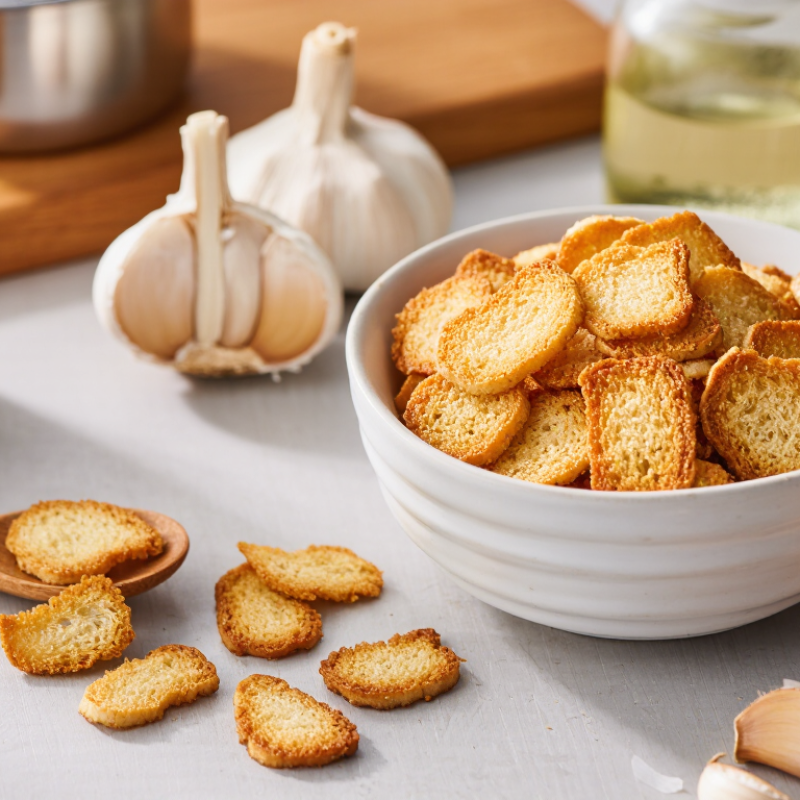
Toasted Garlic Fundamentals: Forms, Processing Stages, and 6–12-Month Shelf Life
Toasted garlic comes in flakes, granules, minced pieces, and powder. Each form suits different global food applications. Flakes provide visible texture.
Powder disperses quickly in sauces and seasoning blends.
Granules offer a middle ground between appearance and mixing speed.
Processing usually follows five stages: cleaning slicing drying toasting cooling. The final product must cool before packing. Residual heat can create condensation inside bags. That moisture may soften flakes and encourage quality loss.
Many processors target water activity below 0.60, then verify it with a calibrated meter. USDA FoodKeeper guidance gives several dried spices longer best-quality periods. However, toasted garlic often carries a stricter commercial shelf-life target of 6–12 months.
Aroma, color, and crispness usually decline before obvious spoilage appears. FAO food-loss research also identifies moisture, oxygen, and temperature as major causes of quality deterioration in dried foods. These risks deserve attention, not optimistic paperwork.
Tips: Ask suppliers for water-activity results, moisture limits, packing dates, and storage trials. Prefer high-barrier packaging with oxygen control. Store cartons below 25°C, away from sunlight and humidity. Check whether the stated shelf life applies to unopened packs only. I would not accept “one year” without test conditions. Shelf life is not a universal promise. It depends on particle size, oil content, packaging, and warehouse discipline.
Global Supplier Landscape: Comparing 10 Exporters by Origin, Capacity, and MOQ
Global buyers should compare ten exporter groups by origin, capacity, and minimum order quantity (MOQ), not by price alone. FAOSTAT’s 2023 release records global garlic production above 28 million tonnes, with China supplying the largest share. India follows with strong domestic processing capacity. China-based exporters often offer 1,000–5,000 tonnes annually, while Indian suppliers commonly range from 300–2,000 tonnes. Spanish and Egyptian exporters usually provide 200–1,500 tonnes, supported by established dried-garlic networks. Argentina, Mexico, and Türkiye often operate between 100 and 800 tonnes. These figures are indicative, not audited. That distinction matters.
ITC Trade Map data for HS 071290, covering dried vegetables and related products, shows active cross-border trade but does not isolate toasted garlic perfectly. Buyers should therefore request product-specific evidence. Typical MOQs range from 100 kilograms for trial orders to 5 tonnes for container planning. Smaller MOQs may carry higher packaging costs. Large-volume contracts can reduce unit pricing, but they may restrict roast intensity and granule size. Ask for moisture, water activity, mesh size, microbiological results, and allergen controls. A 2023 FAO food-safety framework also supports documented traceability and hazard-based controls. Do not rely on certificates alone. One practical weakness remains: supplier capacity figures are often self-reported, and seasonal shortages can disrupt an otherwise reliable origin. A factory video is useful, but an independent audit is stronger.
Quality Benchmarks: ≤7% Moisture, 8–16 Mesh, and Microbial Compliance
10 Best Toasted Garlic Suppliers for Global Buyers
For global buyers, toasted garlic quality starts with measurable controls, not attractive product photos. Moisture should remain at or below 7% to reduce clumping, discoloration, and storage deterioration. Ask for lot-specific test results, not a general specification sheet. Small details matter.
An 8–16 mesh range gives a useful balance between visible texture and consistent cooking performance. During supplier evaluations, I check sieve results from multiple production lots. A single retained sample can hide uneven sizing. It happens. The garlic should also show an even golden color, a clean toasted aroma, and no burnt fragments. Packaging must protect the product from humidity during ocean transport.
Microbial compliance deserves equal attention. Reliable suppliers should provide current testing for total plate count, yeast and mold, Salmonella, and other buyer-specified organisms. Reports should identify the lot, test date, laboratory, and applicable market requirements. Traceability records should connect raw garlic, processing, packing, and shipment. A certificate without traceable evidence is weak support. Buyers should review the supplier’s HACCP-based controls, sanitation records, allergen handling, and corrective-action history. I would also request an independent pre-shipment test for higher-risk routes. This adds cost, but it can expose moisture drift or microbial gaps before arrival. Supplier comparisons should include these verification costs, not only the quoted price.
10 Best Toasted Garlic Suppliers for Global Buyers - Quality Benchmarks: ≤7% Moisture, 8–16 Mesh, and Microbial Compliance
| Supplier ID | Supply Region | Product Form | Moisture | Particle Size | Total Plate Count | Yeast & Mold | Pathogen Status | Quality Certifications | Typical MOQ | Standard Lead Time |
| Supplier 01 | East Asia | Toasted garlic granules | 4.8% | 8–16 mesh | 18,000 CFU/g | 260 CFU/g | Salmonella absent/25 g | HACCP; ISO 22000 | 500 kg | 18–25 days |
| Supplier 02 | South Asia | Toasted garlic flakes | 5.6% | 8–16 mesh available | 24,000 CFU/g | 340 CFU/g | E. coli absent/g | BRCGS; HACCP | 1,000 kg | 20–30 days |
| Supplier 03 | Central Asia | Toasted garlic granules | 5.1% | 10–16 mesh | 31,000 CFU/g | 410 CFU/g | Salmonella absent/25 g | ISO 22000; Kosher | 300 kg | 25–35 days |
| Supplier 04 | North America | Toasted garlic pieces | 4.2% | 8–12 mesh | 12,000 CFU/g | 180 CFU/g | Salmonella absent/25 g | SQF; HACCP; Organic option | 250 kg | 14–21 days |
| Supplier 05 | Western Europe | Toasted garlic granules | 3.9% | 8–16 mesh | 9,500 CFU/g | 150 CFU/g | E. coli absent/g | BRCGS; IFS Food | 200 kg | 21–28 days |
| Supplier 06 | South America | Toasted garlic granules | 6.3% | 8–16 mesh | 42,000 CFU/g | 620 CFU/g | Salmonella absent/25 g | HACCP; ISO 22000 | 500 kg | 28–40 days |
| Supplier 07 | Eastern Europe | Toasted garlic flakes | 5.9% | 8–14 mesh | 27,000 CFU/g | 390 CFU/g | E. coli absent/g | FSSC 22000; HACCP | 400 kg | 24–32 days |
| Supplier 08 | Middle East | Toasted garlic pieces | 6.7% | 8–16 mesh available | 36,000 CFU/g | 580 CFU/g | Salmonella absent/25 g | HACCP; ISO 9001 | 750 kg | 25–38 days |
| Supplier 09 | Southeast Asia | Toasted garlic granules | 4.5% | 8–16 mesh | 16,000 CFU/g | 220 CFU/g | E. coli absent/g | BRCGS; HACCP; Halal | 600 kg | 18–28 days |
| Supplier 10 | Oceania | Toasted garlic granules | 4.0% | 8–16 mesh | 11,000 CFU/g | 170 CFU/g | Salmonella absent/25 g | SQF; HACCP; Allergen control | 250 kg | 21–30 days |
Certification and Traceability Checks: HACCP, ISO 22000, BRCGS, and Lot Records
When evaluating toasted garlic suppliers, certification should be verified before price or packaging. HACCP documents should identify hazards linked to drying, roasting, cooling, and foreign-material control. Ask for the latest audit date, scope, certificate number, and issuing body. A certificate alone is not enough.
ISO 22000 can show how the supplier manages a wider food safety system. BRCGS certification may provide stronger evidence of site discipline, hygiene controls, product testing, and corrective actions. Check whether the certificate covers toasted garlic, not only another product category. Scope matters.
Traceability should work in both directions. Request a sample lot record showing the raw garlic origin, processing date, roasting parameters, operator checks, packaging code, and dispatch details. A reliable supplier should trace one lot quickly, without searching through disconnected spreadsheets. Test this process with a real sample. It may reveal gaps.
Look for moisture results, microbiological reports, allergen statements, and metal detector records. Confirm that laboratories use suitable methods and maintain clear sample identification. In my experience, missing signatures often matter more than polished documents. Records can be complete yet weak. Ask how deviations were handled, not just whether they occurred. Suppliers willing to show corrective actions usually demonstrate greater operational maturity. Also review recall exercises, retention samples, and warehouse temperature logs before approving a long-term supply relationship.
Buyer Scorecard: Pricing, Incoterms, Lead Times, and Sample-Test Results
10 Best Toasted Garlic Suppliers for Global Buyers
A practical shortlist of ten toasted garlic suppliers should begin with a buyer scorecard, not attractive catalog photos. I would assign pricing 25 points, product quality 30, Incoterms 15, lead times 15, and documentation 15. Prices should be compared per finished kilogram, including packaging and inland delivery. Low quotes can hide inconsistent granulation.
Incoterms change the real purchase cost. FCA may suit buyers with strong freight control, while DDP simplifies delivery but needs careful tax review. Ask suppliers to state the named place clearly. Lead times also need evidence. A reliable offer separates production days, testing days, and transit days. Seven-day production sounds impressive. It may not include laboratory release.
Sample-test results should carry serious weight. Test at least three lots when possible. Check moisture, color uniformity, toasted aroma, crunch, and particle size. Request microbial results, allergen statements, and lot traceability. A useful sample arrives in sealed, labeled pouches with a matching certificate. Record the sample weight and test date. Small details matter.
A scorecard can expose uncomfortable trade-offs. One supplier may offer the best price but fail a moisture target. Another may deliver quickly but use weak outer cartons. I would score failures openly instead of adjusting the spreadsheet to protect a favorite. My own early evaluations sometimes overvalued fast replies. Response speed is useful, but it is not proof of stable production. Samples reveal more.
10 Best Toasted Garlic Suppliers for Global Buyers
Buyer Scorecard: Pricing, Incoterms, Lead Times, and Sample-Test Results
The anonymized benchmark compares supplier performance across four buyer priorities. Scores are normalized from 0 to 100, with higher values indicating more favorable pricing, stronger delivery performance, more flexible Incoterms, and better sample-test results.
Benchmark assumptions: bulk toasted garlic FOB pricing of approximately US$2.40–4.20/kg, standard lead times of 15–35 days, common terms including FOB, CIF, and CFR, and sample testing based on appearance, aroma, moisture, texture, and microbiological compliance.