10 Tips for Choosing an Automatic Bag Filling Machine
Selecting an automatic bag filling machine is a production decision, not merely a purchasing task. The right system must match product behavior, bag material, output targets, and workplace conditions. PMMI’s State of the Industry reports consistently highlight automation, labor efficiency, and equipment flexibility as major packaging priorities. These pressures are visible on the factory floor. A machine that fills powder smoothly may struggle with sticky granules or fragile products.
Market research supports this broader shift. Grand View Research reports continued growth in the global packaging machinery market, driven by automation, changing consumer formats, and higher productivity expectations. Meanwhile, FPA and PMMI publications emphasize that flexible packaging performance depends on sealing quality, material compatibility, and process control. These findings make machine selection more technical than comparing hourly speed.
An automatic bag filling machine should therefore be evaluated through practical evidence. Check fill-weight accuracy, changeover time, dust control, cleaning access, and spare-parts support. Ask suppliers for product trials using your actual material and bag dimensions. Watch the discharge point closely. Small residues can become large maintenance problems.
There is no universal winner.
In real facilities, the fastest machine on paper may create more waste, downtime, or operator adjustments. Energy use also deserves attention, although brochures sometimes provide incomplete figures. A reliable decision combines test results, total cost of ownership, operator feedback, and verified service capabilities. The following ten tips provide a structured way to compare equipment honestly, while leaving room to question assumptions that appear attractive during a sales demonstration.
Define Product and Bag Requirements: 0.1–50 kg Fill Ranges and Material Flow
Define Product and Bag Requirements: 0.1–50 kg Fill Ranges and Material Flow
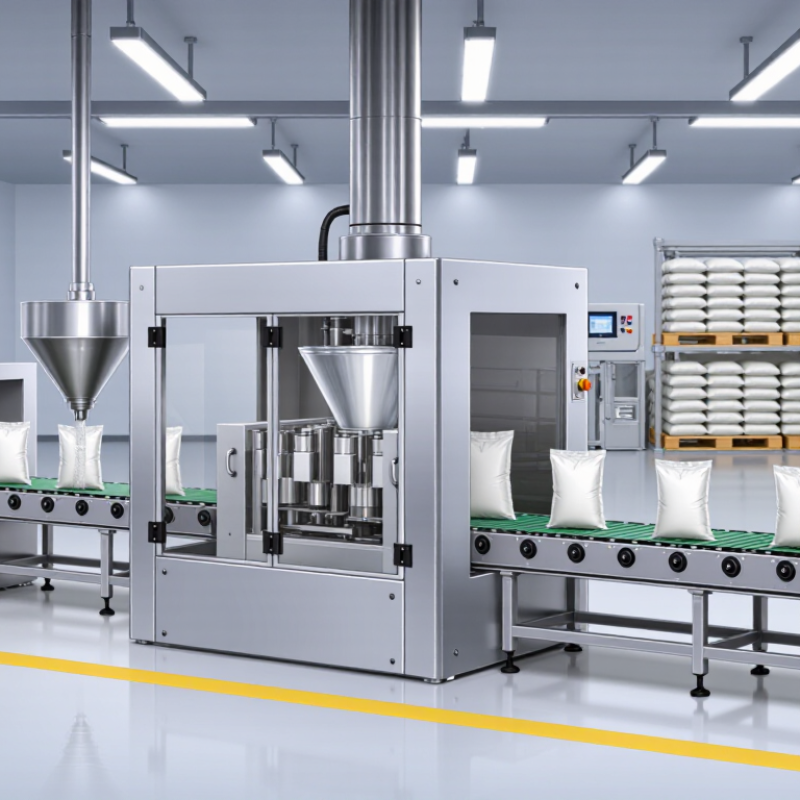
Choosing an automatic bag filling machine begins with the product, not the machine. Confirm the target weight, bag dimensions, opening style, and daily output. A 0.1 kg pouch needs different weighing resolution than a 50 kg sack. Small errors become expensive at scale. UNEP’s Food Waste Index 2024 estimated 1.05 billion tonnes of food waste in 2022, showing why accurate portioning and secure packaging matter.
Study material flow carefully. Free-flowing grains may suit gravity or auger feeding, while flour, powder, and flakes can bridge, dust, or compact. Test bulk density, moisture, particle size, and angle of repose under real conditions. PMMI industry reporting continues to identify labor availability and automation as important packaging investment drivers. However, automation cannot repair poor product data. That mistake is common.
Ask for trial runs across the full 0.1–50 kg range. Record weighing deviation, filling speed, dust release, and bag stability. Check the lowest and highest weights separately. A machine that performs well at 25 kg may struggle at 0.1 kg. It happens. ISO 12100 risk-assessment principles also support evaluating access points, moving parts, and foreseeable operating errors before purchase. Leave room for reflection: your first product sample may not represent seasonal moisture or actual production behavior. Retest before approving the final specification.
Match Output Capacity: Compare 20–120 Bags per Minute with Demand
A filling machine’s speed should follow real demand, not a sales brochure. The 20–120 bags-per-minute range covers a sixfold capacity difference. For a line running 60 bags per minute, one hour theoretically produces 3,600 bags. Changeovers, film replacement, product settling, and rejects reduce that figure. A practical planning factor is often 70–85% of rated output.
PMMI’s recent State of the Industry reporting places the U.S. packaging machinery market above 10 billion dollars annually, reflecting continued investment in automated production. Smithers also forecasts steady global packaging growth through 2028. These figures support automation, but they do not justify buying the fastest machine. A small operation may need only 20–40 bags per minute. A high-volume plant could require 80–120.
Measure hourly orders for normal and peak weeks. Then divide demand by available production minutes. Leave room for maintenance and future growth. For example, 18,000 bags across a six-hour shift requires 50 bags per minute before efficiency losses. At 80% utilization, a machine rated near 63 bags per minute is more realistic.
Do not ignore product behavior. Powder, granules, and irregular pieces can fill differently. I have seen theoretical speed look impressive, while unstable weighing caused frequent stops. Test samples under actual conditions. The correct capacity is the speed the line sustains, not its highest displayed number.
10 Tips for Choosing an Automatic Bag Filling Machine
Match Output Capacity: Compare 20–120 Bags per Minute with Demand
The chart compares estimated production demand with common nominal machine capacities. Selecting the next available capacity above demand provides operating headroom for normal speed variation, material changes, and short production interruptions.
Set Accuracy Standards: Target ±0.1–0.5% Weight Variation per Bag
Set the specification before comparing automatic bag filling machines. A target of ±0.1–0.5% weight variation per bag demands careful testing. For a 25-kilogram bag, ±0.1% equals only 25 grams. ±0.5% allows 125 grams. That difference affects giveaway, customer trust, and material costs. The USDA Economic Research Service reports that roughly 30% of the U.S. food supply is lost or wasted. Accurate filling cannot solve every loss problem, but it can reduce avoidable overfilling.
Ask suppliers for verified data from your product, bag, and target speed. Test at least 30 consecutive bags, then record the average, range, and standard deviation. Check performance during hopper refilling and near-empty conditions. OIML R 61-1 and NIST Handbook 44 emphasize controlled testing, repeatability, and suitable verification procedures for weighing instruments. Their guidance supports a practical point: one impressive sample is not enough. A machine may reach ±0.1% with stable granules, then drift beyond ±0.5% when moisture changes. That assumption can fail. Request calibration records, load-cell specifications, and reject-rate data. Include operator adjustments in the trial. Real production is rarely perfect. Allow time for inspection, cleaning, and recalibration. A slightly wider target may be more reliable than an ambitious number achieved only under showroom conditions.
Compare Total Cost of Ownership: Assess 3–5-Year Maintenance and Energy Costs
When choosing an automatic bag filling machine, compare its total cost of ownership over three to five years. Purchase price is only the visible number. Record electricity consumption, compressed-air demand, replacement parts, labor hours, and planned downtime. The International Energy Agency reports that electric motor systems use nearly half of global electricity, making drive efficiency a serious operating concern. A machine drawing 3 kW for 2,000 hours annually uses about 6,000 kWh each year. Multiply that figure by your local tariff and expected energy increases.
Maintenance deserves equal attention. Request service intervals, lubrication requirements, sensor life, and the price of wear components. The U.S. Department of Energy notes that compressed-air leaks can waste 20–30% of compressor output. Inspect hoses, valves, and seals during a site trial, not only during installation. A small leak may sound harmless. Over five years, it becomes an invoice. Include technician travel, emergency repairs, and lost production in the calculation.
Use three scenarios: normal operation, heavy use, and delayed maintenance. This exposes optimistic assumptions. The spreadsheet will not be perfect. Energy prices change, and operators sometimes run equipment longer than planned. Track real electricity and downtime data after commissioning, then revise the estimate annually. A lower-cost machine can become expensive if cleaning takes longer, changeovers require extra labor, or spare parts are difficult to source. Industry life-cycle costing guidance from the U.S. Department of Energy supports evaluating energy and maintenance together, rather than judging equipment by purchase price alone.